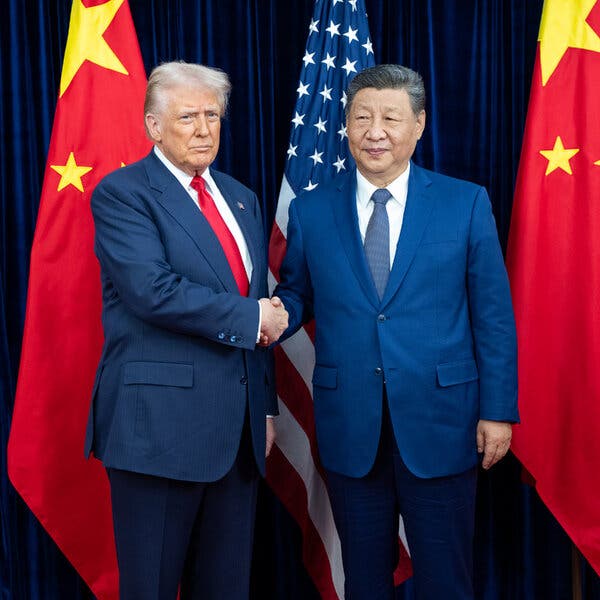
Air Force One Lands in Beijing: Trump Arrives With Billionaires, Big Demands, and a War He Needs China to Help End
Summary
United States President Donald Trump has touched down in Beijing for a high-stakes state visit, the first by an American president to China in nearly nine years and the most consequential diplomatic encounter of his second term so far. Trump was greeted on the tarmac at Beijing Capital International Airport by a brass band and flag wavers, with Chinese Vice President Han Zheng leading the official reception party as Air Force One's stairs were lowered. Alongside him on the plane were Secretary of State Marco Rubio, Defense Secretary Pete Hegseth, Trade Representative Jamieson Greer and on the tarmac beside him, Apple CEO Tim Cook, Tesla CEO Elon Musk, and Nvidia CEO Jensen Huang, who joined the trip at the last minute during a stopover in Alaska. The agenda is enormous. The leverage, analysts warn, may not be.
He came with his billionaires. That tells you almost everything about what Donald Trump thinks this trip is for.
Cook, Musk, and Huang three of the most powerful technology executives on the planet, each with billions of dollars in Chinese manufacturing, supply chains, or market exposure were not brought to Beijing as window dressing. For many of these executives, China is both a vital manufacturing hub and a massive consumer market they want to keep tapping, even as trade tensions between the world's two largest economies continue to swirl. Trump brought the CEOs because trade is his primary stated objective. But the world is watching for something else entirely.
Trump has arrived in Beijing after weeks of unsuccessful American efforts to persuade China to help bring Iran back to nuclear negotiations and ease the crisis strangling the Strait of Hormuz a waterway whose partial blockade has rattled global oil markets, pushed energy prices to painful levels, and weighed on economic growth in virtually every major economy on earth. The ceasefire between the US-Israel coalition and Iran is, by Trump's own description, on "massive life support." He needs it to hold. And holding it, at this point, may require Chinese pressure that Washington has so far been unable to generate through any other channel.
The visit was originally scheduled for April but was postponed to May specifically because of the Iran war a conflict that erupted weeks after the US and Israel launched military operations and has since consumed the diplomatic bandwidth of the entire Western alliance. That postponement is itself a signal. Beijing, by accepting the rescheduled visit without demanding concessions up front, positioned itself as the indispensable party the country without whose cooperation the most powerful nation on earth cannot resolve its most urgent foreign policy crisis.
Some US officials have expressed concern that Trump is walking into a meeting where Xi holds the cards and that the Chinese leader may use that leverage to extract concessions on an issue important to Beijing: Taiwan. Trump, ahead of departure, was characteristically unbothered. "He'll bring up Taiwan, I think, more than I will," he told reporters Monday. It was either genuine confidence or studied nonchalance and nobody in the room was entirely sure which.
On May 11, Trump broke with decades of US policy tradition by announcing he would discuss arms sales to Taiwan with Xi a departure from the Six Assurances framework that has governed US-Taiwan arms policy since 1982. That announcement landed with the diplomatic equivalent of a thunderclap in Taipei, Canberra, and Tokyo. Whether it was a negotiating gambit or a genuine policy pivot remains unclear.
Thursday's schedule includes a formal welcome ceremony, a bilateral meeting with Xi Jinping, a tour of the historic Temple of Heaven, and a state banquet. Huang's presence on the trip is particularly loaded. His initial absence from the invitation list had been notable, given China's intense demand for semiconductor technology and the US export controls designed to prevent advanced chips from reaching Chinese firms. His last-minute addition boarding during an Alaska stopover suggests backroom negotiation on technology access was still ongoing even as Air Force One was in the air.
Experts say Iran may be one of the few genuine areas where US and Chinese interests overlap both countries benefit from stable energy flows through the Gulf, and both are absorbing economic pain from the Strait of Hormuz disruption. But Beijing's willingness to translate that shared interest into active diplomatic pressure on Tehran is far from guaranteed. "Both sides would like to see the strait opened," said Gregory Poling of CSIS. "But the diplomatic and strategic pressure created by the disruption is falling far more heavily on Washington." China, in other words, can afford to wait. America, with a ceasefire on life support, cannot.
Eric Trump and his wife Lara also made the journey travelling in a personal capacity, a detail that Reuters noted may represent a conflict of interest given that Eric manages the Trump Organisation's business operations. It is, by any measure, a crowded plane.
Analysis
The symbolism of this visit is genuinely historic. A sitting American president has not set foot in China since Trump himself did in 2017 nearly nine years ago, before a trade war, a pandemic, a technological decoupling, and a shooting war in the Middle East fundamentally altered the relationship between the two countries. That he is back in Beijing, at Xi's invitation, is significant regardless of what the meetings produce. It signals that both sides have decided, at least for now, that direct engagement is preferable to managed rivalry conducted through intermediaries and press statements. But the power dynamics of this particular visit are unusually unfavourable for Washington. Trump came to Beijing needing things. He needs China's help or at minimum, China's non-interference in ending a war that is costing America economically and diplomatically. He needs Chinese cooperation on trade terms that he can sell to a domestic audience as a win. He needs Nvidia's Jensen Huang to get some assurance about chip access so that Silicon Valley stops lobbying against his export controls. And he needs all of this without appearing to concede anything significant on Taiwan, which is the one currency Beijing most wants to collect. Xi Jinping, by contrast, arrived at this summit having already extracted a meaningful concession before the talks even formally began Trump's pre-trip announcement about discussing Taiwan arms sales. Whether that was a genuine policy shift or a negotiating chip to be traded away at the banquet table will become clear in the coming days. But the optics of an American president volunteering to discuss restricting arms to a democratic ally before the bilateral meeting has even started are not optics that project strength. The CEOs beside Trump on that tarmac are perhaps the most honest representation of what this visit is really about two great powers, deeply entangled economically despite years of political theatre about decoupling, searching for a formula that lets them keep doing business while maintaining the fiction of strategic competition. Cook needs China for Apple's supply chain. Musk needs China for Tesla's manufacturing. Huang needs China for Nvidia's market. And Trump needs all three of them to keep generating the kind of economic activity that his presidency depends on for its legacy narrative. None of that is solved by a state banquet at the Great Hall of the People. But it's why the plane was full. The world will find out on Friday what, if anything, was agreed. Until then a brass band, a Temple of Heaven tour, and the most consequential two days in US-China relations since the pandemic began.
Tags