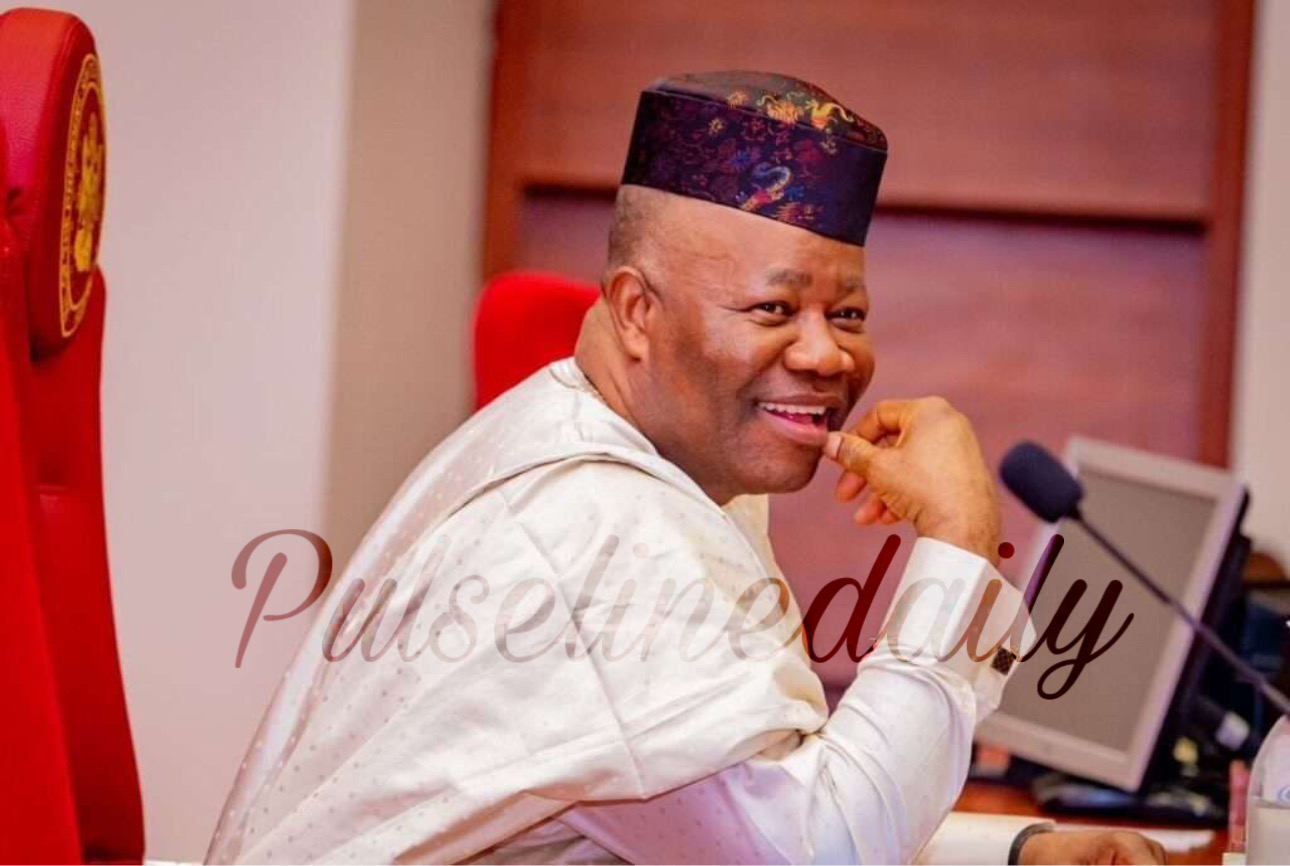
“We Are Not Going Back to the Stone Age”: Akpabio Rejects MTN, DSTV Licence Revocation, Urges Diplomacy Over Economic Retaliation
Summary
Senate President Godswill Akpabio has publicly rejected Senator Adams Oshiomhole’s call to revoke the operating licences of South African companies MTN and DSTV in response to xenophobic attacks on Nigerians, warning that such action could endanger South Africans living in Nigeria and undermine the country’s foreign investment appeal. Speaking during Tuesday’s Senate plenary, Akpabio urged the chamber to restrict itself to a formal condemnation and a directive to the Federal Government, rather than economic retaliation. His intervention effectively closed the debate on licence revocation at least for now and defined the Senate’s official position as one of diplomatic pressure rather than commercial confrontation.
When Senate President Godswill Akpabio rose to close Tuesday’s debate on the xenophobic attacks against Nigerians in South Africa, he did so with a clarity of position that drew a firm institutional line between the Senate’s anger and the policy it would endorse. His message to the chamber and to the watching public was unambiguous: economic retaliation is not where Nigeria goes from here.
Oshiomhole’s proposal to revoke the operational licences of MTN and DSTV was ultimately declined on procedural grounds, with the Senate President emphasising diplomatic engagement as the preferred path, stating that economic retaliation against businesses would not be the preferred course of action.
Akpabio’s reasoning was threefold. First, Nigeria’s need for foreign investment is too urgent to risk by signalling that licences can be revoked in response to political tensions between governments. “We need foreign investments in Nigeria,” he stated plainly a position that reflects both economic pragmatism and an awareness that investors globally watch how states treat existing foreign businesses when bilateral relations become strained. A Senate that votes to nationalise a major telecom operator in the heat of a diplomatic crisis sends a message about regulatory stability that extends far beyond the South Africa question.
Second, the Senate President raised the issue of reciprocity from a human angle not the economic reciprocity that Oshiomhole invoked, but its humanitarian consequence. “We have a lot of South Africans living in Nigeria, and if we start dragging them and killing them, we are returning to the Stone Age,” Akpabio said. The warning was a deliberate inversion of the xenophobia argument: the same logic that condemns South Africans for targeting foreign nationals on their soil cannot sanction Nigerians doing the same. A country that positions itself as the moral aggrieved party in a xenophobia crisis cannot simultaneously endorse mob action against another nationality on its own streets.
Third, Akpabio was careful to define what the Senate would do making clear that restraint in form did not mean passivity in intent. In its resolutions, the Senate urged the Federal Government to immediately initiate high level diplomatic dialogue with South Africa and Ghana to secure protection for Nigerians, called for a full and independent investigation into all reported incidents, insisted that perpetrators and their sponsors be identified, arrested, prosecuted and punished, and pressed for strong regional enforcement within ECOWAS and the African Union to deter xenophobia through diplomatic and legal action.
The Senate also resolved to constitute a joint ad hoc committee with the House of Representatives to address the rising cases of xenophobic attacks against Nigerian nationals in South Africa. The House of Representatives, sitting simultaneously, mandated its Committee on Foreign Affairs to work with the Nigerian High Commission in Pretoria to establish a 24 hours emergency response desk and a legal aid fund for affected citizens.
Akpabio also moved to define the Senate’s moral register without endorsing economic aggression: “We should, as a Senate, condemn what we are seeing happen to Nigerians in South Africa and urge the Federal Government to take serious steps and revert to us as soon as practicable.” The directive to “revert to us” is politically important it keeps the Senate in the accountability loop and ensures that the government’s diplomatic response is subject to legislative scrutiny rather than proceeding without oversight.
Analysis
Akpabio’s intervention is the Senate acting as an institution rather than a rally and that distinction matters enormously in this context. Oshiomhole’s remarks captured the emotional truth of the moment: Nigerians are dying, and the country’s response has historically been to mourn rather than act. That frustration is legitimate and widely shared. But the Senate President’s responsibility is not simply to reflect the room’s anger. It is to direct institutional energy toward responses that are proportionate, legally defensible, and strategically sound. The foreign investment argument is not cynical it is accurate. Nigeria is simultaneously courting billions of dollars of investment commitments at the Africa CEO Forum in Kigali this week, with President Tinubu making the case for the country as a destination for global capital. A Senate resolution to nationalise one of Africa’s largest telecom operators, passed in the same week, would land in every boardroom and investment committee that watched the Kigali forum with a very different message. The cost of that signal in investor confidence, in credit ratings, in the pipeline of foreign direct investment Nigeria desperately needs is real and would be borne by ordinary Nigerians rather than by the South African government. The Stone Age comment, however, is the line that will generate the most discussion. It is blunt to the point of sounding dismissive and in the context of a debate about the deaths of Nigerian citizens, dismissiveness is politically costly. Akpabio’s instinct is right: mob violence against South Africans in Nigeria would be morally indefensible and practically catastrophic. But the framing could have been more empathetic to the rage that senators like Oshiomhole, and the millions of Nigerians behind them, are expressing. What Nigeria needs from this moment is not licence revocations or mob retaliation but a government that, this time, follows through on its diplomatic commitments with the same urgency it brings to foreign investment pitches. The ad hoc committee, the 24 hours Pretoria desk, the AU pressure campaign these are the right tools. The test is whether they are wielded with consequence or filed alongside every previous Nigerian diplomatic protest about xenophobia that South Africa ultimately ignored.
Tags