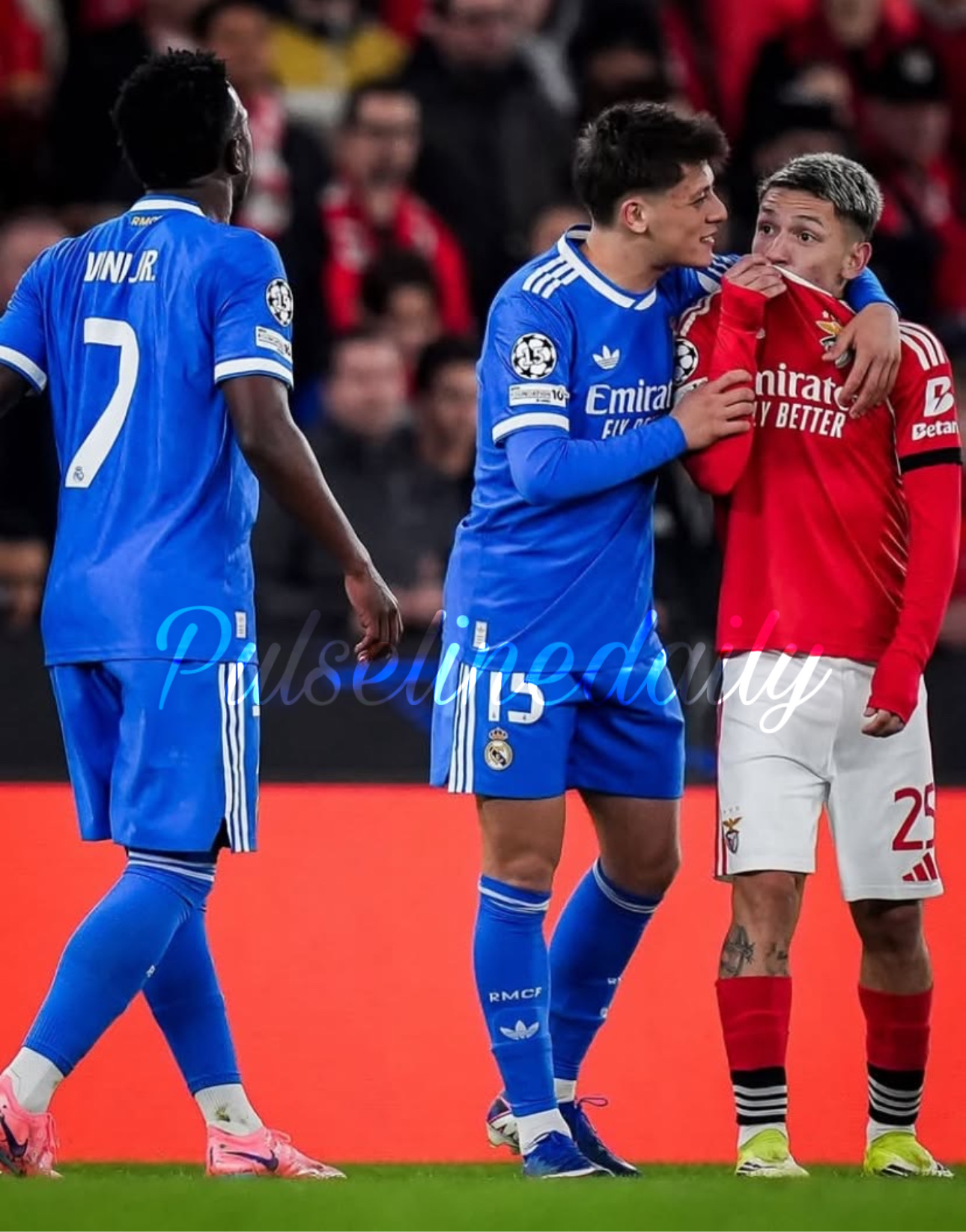
UEFA Bans Benfica’s Prestianni Six Games for Homophobic Abuse of Vinicius Jr. and Asks FIFA to Go Further
Summary
UEFA has handed Benfica winger Gianluca Prestianni a six match ban for homophobic discriminatory conduct directed at Real Madrid’s Vinicius Jr. during a Champions League playoff match in February. The governing body has also formally requested FIFA to extend the suspension worldwide a move that could rule the 20 years old Argentine out of the 2026 World Cup.
Benfica’s Gianluca Prestianni has been handed a six match suspension by UEFA for discriminatory conduct deemed homophobic during a Champions League playoff match against Real Madrid.
The ban was issued on Friday, with UEFA citing “discriminatory conduct” and specifying the offense involved “homophobic insults” with Prestianni reportedly directing the Spanish slur “maricón” at the Brazilian forward.
The incident took place during Real Madrid’s 1-0 first leg win at the Estádio da Luz in February. The match was suspended for 11 minutes shortly after Vinicius scored, with television footage showing Prestianni covering his mouth with his shirt while making comments that Vinicius and nearby teammates interpreted as abusive.
Vinicius Jr., along with Kylian Mbappé and Aurélien Tchouaméni, all reported that Prestianni had called him a “monkey.” The match was suspended for 10 minutes as UEFA enacted its anti-racism protocol, and an investigation was launched in the days that followed.
Prestianni denied making a racist comment, saying Vinicius had misheard him. Tchouaméni confirmed that Prestianni told him he had not called Vinicius a “monkey” but had directed a homophobic comment at him instead.
Three of the six matches in the ban are suspended for a two-year probationary period, and the total includes the one match provisional suspension Prestianni already served ahead of the second leg. In effect, unless he triggers the suspended portion of the ban, he will only miss two further games.
Since Benfica have been eliminated from European competition, Prestianni will serve the remaining suspension with the Argentina national team, should he receive a call up for the 2026 World Cup.
UEFA has formally asked FIFA to extend the suspension worldwide.
Analysis
This ruling arrives with a weight that extends far beyond one player or one match. The Prestianni Vinicius incident cut to the heart of football’s ongoing and often painful reckoning with racism, homophobia, and the limits of its own disciplinary systems. The fact that UEFA’s investigation ultimately classified the abuse as homophobic rather than racist is significant, and not without controversy. Multiple witnesses, including Vinicius himself and two of his Real Madrid teammates, reported hearing a racial slur. Prestianni’s own defense that he used a homophobic insult, not a racist one essentially asked the sport’s governing body to distinguish between two forms of discriminatory abuse. UEFA accepted that framing, and critics will rightly question whether that distinction softened what was, by any measure, an act of targeted verbal abuse toward one of the world’s most high profile players. The leniency of the effective punishment has already drawn sharp reactions. A six match ban sounds significant on paper, but with three matches suspended and one already served, Prestianni walks away needing to sit out just two more games. For a player on a club that is no longer active in European competition, the immediate practical consequence is minimal. The real stakes now shift to FIFA. UEFA’s formal request that FIFA extend the ban globally is the most consequential element of this ruling. Should FIFA comply, Prestianni could be barred from representing Argentina at the 2026 World Cup a tournament being co-hosted by the United States, Canada, and Mexico, and one carrying enormous symbolic weight given the ongoing global conversation around discrimination in football. FIFA president Gianni Infantino has previously signaled a zero tolerance posture on exactly this kind of behavior, which may bode well for a stiffer worldwide sanction. What this case has also done is reignite a broader debate about the act of covering one’s mouth while speaking on the pitch a gesture that, in this context, was widely read as a deliberate attempt to conceal abuse. A new rule addressing that behavior is reportedly expected to be discussed at the International Football Association Board meeting ahead of the FIFA Congress on April 30. If adopted, it would mark a tangible, structural response to a problem that has long evaded clean solutions. For Vinicius Jr., who has spoken repeatedly and openly about the racial abuse he endures in stadiums across Europe, the outcome is likely to feel inadequate. He has carried that burden with a visibility few athletes are willing to sustain, and this case however it is resolved by FIFA will be another data point in a conversation that football has yet to truly win.
Tags