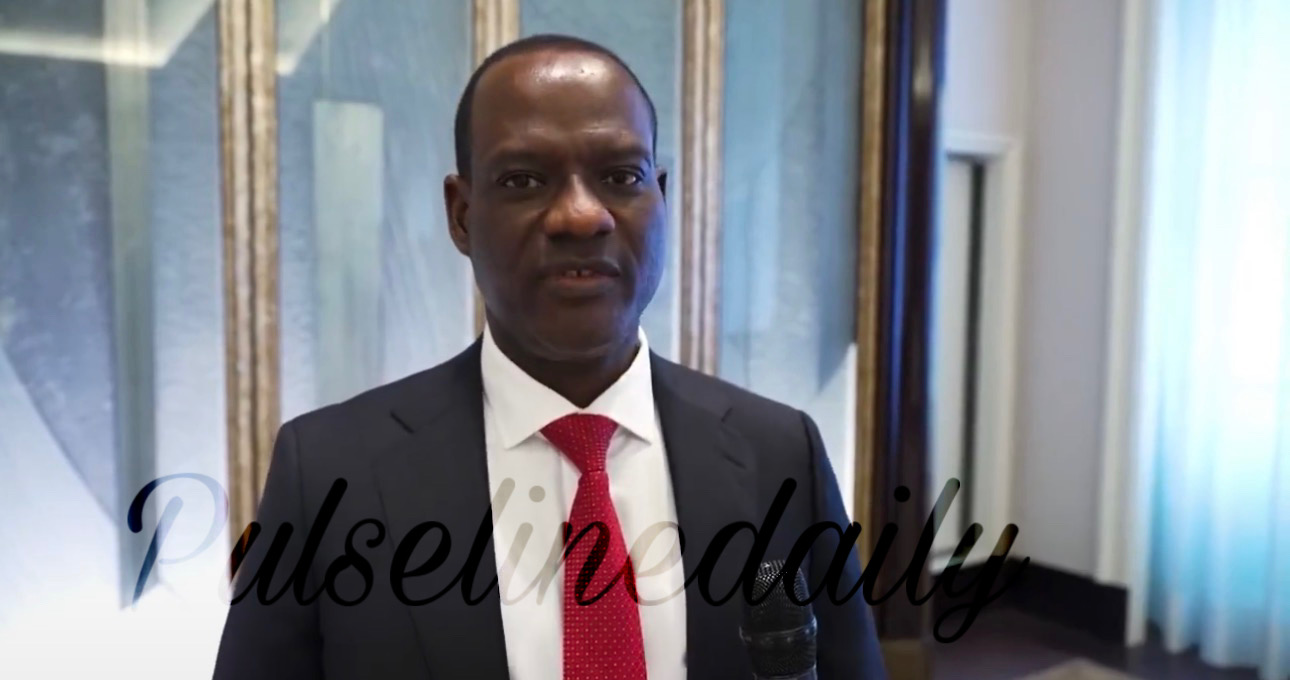
No Subsidy. No Price Controls. And a War That Opens Doors: Oyedele Delivers Nigeria’s Firmest Economic Message Yet in Paris
Summary
Finance Minister and Coordinating Minister of the Economy Taiwo Oyedele used a post meeting press interaction in Paris on Tuesday, May 5, 2026, to deliver the Tinubu administration’s clearest and most uncompromising economic policy statement since the subsidy was removed in May 2023. Speaking on the sidelines of President Tinubu’s investor engagement, Oyedele flatly ruled out any return of fuel subsidy or the introduction of price controls even as the US-Iran conflict drives global fuel prices to multi year highs while simultaneously framing the Middle East crisis as a strategic opportunity for Nigeria to capture investment and market share as the world diversifies its energy sources. NRS Chairman Zacch Adedeji separately disclosed that reinstating the subsidy at current oil prices would have consumed between 56% and 76% of Nigeria’s entire 2026 budget.
In Paris on Tuesday evening, with the cameras of international financial media watching, Finance Minister Taiwo Oyedele delivered what may be the most consequential economic policy declaration of the Tinubu administration since inauguration day. The message was simple, direct, and deliberately unhedged: the subsidy is not coming back, price controls are not on the table, and the war in the Middle East is not a crisis for Nigeria it is an invitation.
“We will not bring back subsidy because it creates destruction for the economy, and we won’t introduce price control because we believe in the market while we ensure that regulation is responsible so that there is no supplier, trader, manufacturer taking advantage of the Nigerian people,” Oyedele told journalists after President Tinubu and the Nigerian delegation concluded their meeting with global investors in Paris on May 5.
The remarks came in response to a question about the growing domestic pressure on the Federal Government to soften its position on fuel pricing in the wake of the US-Iran conflict, which has sent Brent crude above $106 per barrel and pushed pump prices sharply higher across Nigeria. The reassertion of the no subsidy position comes amid growing public pressure to cushion the effect of rising petrol prices linked to the Middle East crisis. Oyedele’s answer left no room for interpretation: the administration’s position has not softened, will not soften, and is being stated on the record before an audience of global institutional investors for maximum credibility.
The numbers behind that resolve are stark. Nigeria Revenue Service Chairman Zacch Adedeji, speaking separately on Tuesday, revealed that at an oil price benchmark of $120 per barrel, Nigeria’s annual subsidy bill could have risen to between N38 trillion and N52 trillion consuming as much as 56 to 76 percent of the country’s N68 trillion 2026 budget. Reinstating the subsidy at current global oil prices would not just strain the government’s finances it would swallow them whole, leaving almost nothing for capital expenditure, education, healthcare, or security. That arithmetic is what gives Oyedele’s firmness its structural foundation.
Adedeji added that eliminating the subsidy has freed up fiscal space, improved external reserves, and helped stabilise the country’s debt service outlook, with revenue collections rising from N711 billion in May 2023 to N3.63 trillion in September 2025 a 411% increase. Those figures represent the tangible fiscal dividend of a reform that cost Nigeria enormous political capital and they are precisely the numbers Oyedele carried into the Paris investor room as evidence that the pain was purposeful.
The second dimension of Oyedele’s Paris statement was equally striking and strategically bolder. “We see the issues going on in Iran. While that is unfortunate, we think it presents new opportunities for us as the world looks to diversify sources of energy and invest in new markets,” he said. The framing is deliberate and significant. As the Strait of Hormuz remains functionally impaired and global buyers scramble for alternative energy sources, Nigeria with its deepwater offshore reserves, its growing gas infrastructure including the newly completed OB3 River Niger crossing, and its improving investment environment is positioning itself as the reliable, accessible African alternative to Middle Eastern supply.
At the formal investor meeting, Oyedele highlighted that Nigeria recorded 11.2% GDP growth in dollar terms in 2025, describing the figure as a foundation for the country’s ambition to achieve a $1 trillion economy by 2030. He also pledged to begin publishing quarterly financial data. Taken together the subsidy firmness, the market confidence language, the Iran opportunity framing, and the data transparency pledge Tuesday’s Oyedele performance in Paris was a masterclass in how to use a geopolitical moment to advance a national economic narrative.
Analysis
Oyedele’s Paris statement matters for three distinct but interconnected reasons. First, it is a credibility signal to investors that the reforms are locked not subject to reversal under popular pressure, not negotiable when oil prices spike, not contingent on the political cycle. For a government that has repeatedly been asked whether the subsidy removal is permanent or whether an election year reversal is possible, stating “no subsidy, no price controls” in front of Citibank, Amundi, and PGIM is the strongest possible form of pre commitment. These institutions do not simply hear the words they update their country risk assessments based on them. Second, the Iran as opportunity framing is a genuine strategic insight, not merely a political spin. Nigeria exports approximately 1.4 to 1.7 million barrels of oil per day, has world-class deepwater assets in OPL 245, OML 118, and the Bonga field, and is simultaneously building out a gas export infrastructure that includes a completed OB3 pipeline and an advancing AKK corridor. The global scramble for non Middle Eastern energy, triggered by the US-Iran conflict, creates a demand environment in which Nigeria’s reserves if the investment and regulatory environment is credible attract exactly the kind of equity and debt capital that the Paris meeting was convened to seek. Third, the regulatory caveat Oyedele attached to his market confidence statement deserves attention. He did not say “no regulation” he said “responsible regulation” that prevents exploitation of consumers. That qualification is the government’s acknowledgment that a pure market signal, without enforcement against market power abuse, can produce outcomes that harm the populations it is supposed to benefit. The NCC’s new subscriber compensation framework and the NBS’s consumer price monitoring mechanisms are the institutional architecture that must give that caveat meaning. Policy declarations in Paris are validated or invalidated by regulatory enforcement back home.
Tags