A Rare Honour: Dangote Inducted as Only the Sixth Distinguished Honorary Fellow of the Nigerian Academy of Engineering
Summary
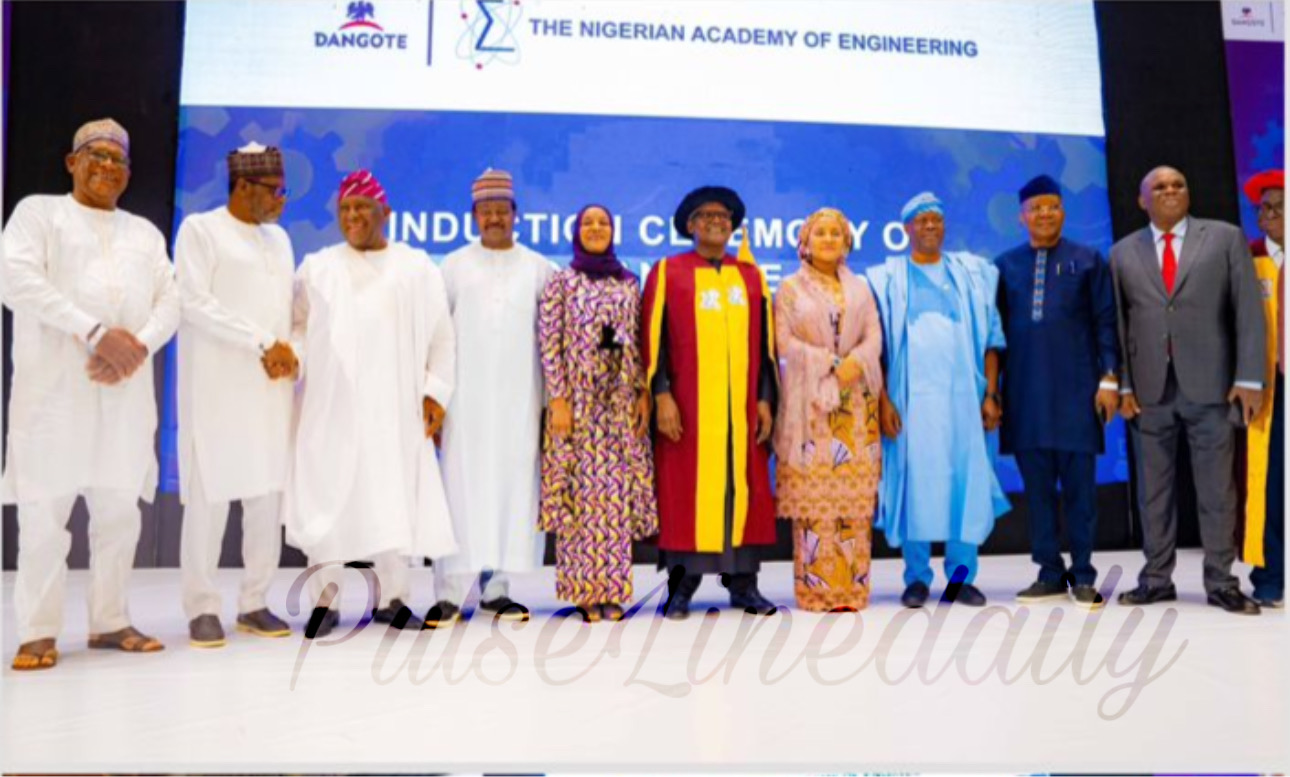
On Friday, April 24, 2026, Africa’s richest man and industrialist Aliko Dangote was inducted as a Distinguished Honorary Fellow of the Nigerian Academy of Engineering at a high-profile ceremony in Victoria Island, Lagos becoming only the sixth recipient of the honour in the academy’s 29 years history. Among the distinguished guests present was BUA Group Founder and Executive Chairman, Alhaji Abdul Samad Rabiu, CFR, CON, in a moment that brought together two of Nigeria’s most powerful industrial figures to celebrate a milestone in engineering led development.
Victoria Island, Lagos became the setting for a landmark moment in Nigerian industry and engineering on Friday, April 24, 2026, as the Nigerian Academy of Engineering (NAE) conferred its rarest and most prestigious recognition on Aliko Dangote inducting him as a Distinguished Honorary Fellow in acknowledgement of his transformative contributions to large-scale engineering and industrial development across Nigeria and Africa.
NAE President, Prof. Rahamon Bello, presided over the ceremony, describing the induction as the academy’s highest recognition — reserved for individuals with outstanding impact on engineering practice and development. He noted that only five Honorary Fellows had been inducted in 29 years, making Dangote the sixth recipient of the rare recognition.
The Nigerian Academy of Engineering, established in 1997, is the apex professional body for engineering in the country and serves as a strategic think-tank on science, technology and innovation. Its membership comprises distinguished Nigerian and international experts drawn from diverse engineering disciplines and industry sectors, and the academy plays a critical advisory role to the Federal Government and private sector on engineering and technological matters.
Prof. Bello said Dangote’s investments span cement manufacturing, sugar refining, salt processing, vehicle assembly, and petroleum refining. He described the Dangote Refinery as Africa’s largest oil refinery and a symbol of engineering excellence and innovation, reflecting belief in Africa’s capacity to design, build, and sustain world-class infrastructure. He added that such investments reduced import dependence, strengthened local capacity, and created thousands of jobs.
Among the distinguished guests who graced the occasion was Alhaji Abdul Samad Rabiu, CFR, CON — Founder and Executive Chairman of BUA Group, one of Nigeria’s foremost conglomerates — whose presence alongside Dangote underscored the significance of the event as a gathering of Nigeria’s most consequential industrial minds. The sight of two of Africa’s most impactful businessmen in the same room, at a ceremony honouring engineering and industry, was not lost on observers.
Dangote received the Distinguished Honorary Fellowship from the President of the academy at the induction ceremony in Victoria Island, Lagos. He was accompanied to the ceremony by his daughters, other family members, and the management of the Dangote Group.
Dangote’s Message: Build What You Consume
In his acceptance remarks, Dangote used the platform to deliver a pointed and forward-looking address on Nigeria’s industrial future. “True economic independence is impossible without technical sovereignty. We must fabricate, design and build what we consume. We will remain the fiercest advocates for local content, which is key,” he declared, highlighting the need for improved electricity infrastructure as critical to industrial growth.
Dangote also warned that the rapid rise of artificial intelligence could significantly reshape the engineering profession, potentially displacing traditional design processes long handled by human experts. He urged engineers to take a leading role in guiding how AI is integrated into both education and practice, stressing the need for innovation to ensure human expertise remains relevant.
He also announced plans for a massive refinery project in East Africa, reportedly targeting a capacity of 650,000 barrels per day as part of a multi-billion-dollar investment strategy, though noting that such projects depend heavily on government collaboration and policy support.
Distinguished Guests and Tributes
The Group Managing Director of ARCO Group Plc, Alfred Okoigun, said engineering must remain central to Nigeria’s development agenda, noting that Dangote’s recognition underscores the need for deliberate investment in engineering capacity. He said countries like China have shown the gains of aligning ambition with technical expertise.
Special Guest of Honour, Prof. Benedict Oramah, commended Dangote’s contributions to Nigeria’s industrial landscape and job creation. Governor Babajide Sanwo-Olu of Lagos was represented by his Special Adviser on Works, Dr Adekunle Olayinka, who said Dangote’s efforts show African innovation can compete globally.
Analysis
The induction of Aliko Dangote as only the sixth Distinguished Honorary Fellow in the Nigerian Academy of Engineering’s 29 years history is a significant institutional statement and a reflection of something that often goes underappreciated in discussions of Nigeria’s business landscape: that industrial development and engineering are inseparable. Dangote is not an engineer by training. But he has arguably done more to advance the practice and scale of engineering in Nigeria than most credentialled professionals. The Dangote Cement plants. The $20 billion Dangote Refinery the largest single-train refinery in the world. Sugar refineries. Vehicle assembly. Each of these required not just capital but engineering vision, project management of extraordinary complexity, and a willingness to undertake infrastructure at a scale that Nigeria’s public sector has consistently failed to attempt. The NAE’s decision to honour him is a recognition that engineering excellence is not confined to those who hold professional certificates it is also embodied in those who commission, fund, and drive engineering to its limits in the service of national development. The presence of Abdul Samad Rabiu at the ceremony adds another dimension of symbolic weight. Rabiu and Dangote occupy similar territory in Nigeria’s industrial economy cement, sugar, food processing, infrastructure and their co-presence at a celebration of engineering-led industrialisation signals an industry that, whatever its competitive dynamics, understands that its long-term strength depends on the elevation of engineering as a national priority. Dangote’s own remarks struck a tone of urgency rather than celebration. His warning about AI’s encroachment on engineering practice is forward-looking in a way that Nigerian institutions rarely are publicly. His insistence that “true economic independence is impossible without technical sovereignty” is not a new argument but it carries weight when it comes from the man who built the largest privately funded infrastructure project in African history largely on that same conviction. The question is whether the recognition of one man’s industrial achievement translates into a broader national commitment to the engineering education, infrastructure investment, and policy environment that would make the next Dangote and the one after that possible. The honorary fellowship is a celebration. The real work begins in the institutions that the celebration is meant to inspire.
Tags